



Producing a reliable solid wood panel involves more than applying glue and tightening a press. Wood moisture, edge preparation, mixing accuracy, adhesive coverage and pressing conditions all influence the finished bond.
Two-component board glue is designed for applications in which a main adhesive is mixed with a separate hardener before use. This system is relevant to manufacturers of solid wood doors, furniture, flooring, integrated boards and other edge-glued wood products.
Desay Chemical lists its PVAC-PB two-component board glue for solid wood doors and windows, furniture, flooring, boards and related wood bonding. The product comprises a main agent and hardener and is intended for application before the wooden components are pressed together.
Why Use a Two-Component System?
A standard one-component woodworking adhesive may be sufficient for many indoor assemblies. However, some production processes require a system in which a hardener is added to the main adhesive immediately before application.
The addition of a hardener starts a limited working period. This makes mixing control essential: operators must prepare only the quantity that can be applied and assembled within the usable time specified for the selected product.
Buyers should not select an adhesive only because it is described as “two-component.” The system must still match the wood species, joint construction, production conditions and performance criteria for the finished panel.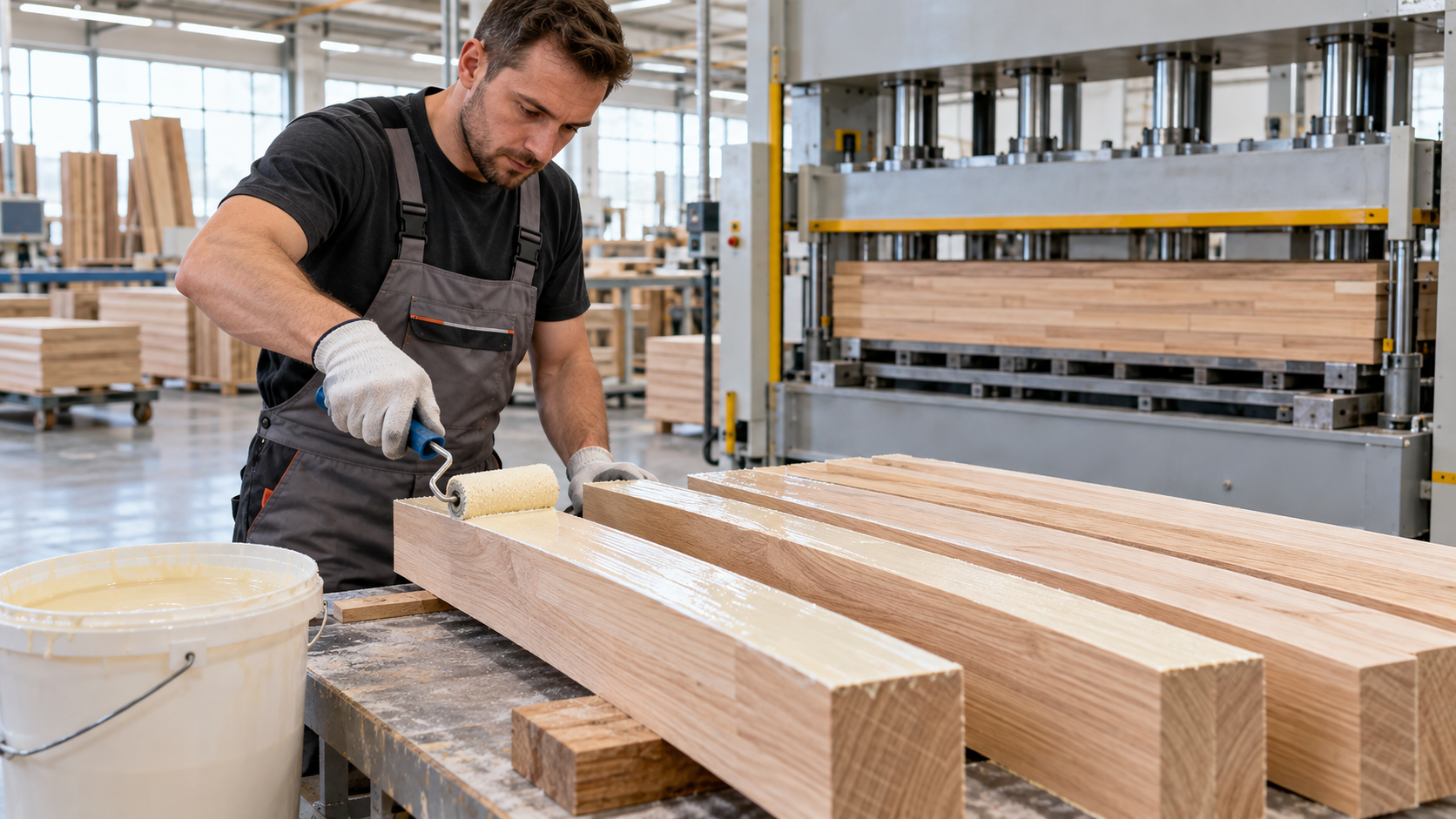
Prepare Accurate Wood Edges
The bonded edges should be straight, flat and able to meet without large gaps. Adhesive cannot compensate for poorly machined timber or excessive warping.
Before gluing, inspect the lamellas for:
- Uneven or damaged joining edges
- Dust from sanding or machining
- Oil or contamination
- Large differences in moisture content
- Bowing, twisting or dimensional variation
- Delays between final machining and bonding
Actual wood moisture should be checked using the factory’s approved method. Desay’s product page provides a recommended moisture range and preparation guidance, but buyers should confirm the current instructions for the supplied grade before establishing production limits. DESAY
Measure and Mix Consistently
The main agent and hardener must be measured according to the ratio stated in the current technical data sheet. Guessing by color or container volume can produce inconsistent curing.
Use clean mixing equipment and scrape the sides and bottom of the container so that the components are blended uniformly. Record the following during trials:
- Quantity of each component
- Mixing start time
- Adhesive and workshop temperature
- Time application begins
- Time panel assembly is completed
- Amount of unused mixed adhesive
Do not return mixed material to the original container. Once the components have been combined, the mixture should be managed according to the supplier’s usable-time and disposal instructions.
Control Adhesive Application
Apply a continuous, even layer to the prepared joining edge. Dry areas may create weak sections, while excessive adhesive increases squeeze-out and unnecessary consumption.
The most suitable applicator depends on production scale. Manual rollers may be practical for trials and smaller batches, while mechanized application can improve consistency in higher-volume panel production.
Check adhesive transfer when the wooden pieces are brought together. The joint should receive coverage across its complete length rather than only at isolated points.
Assemble and Press Without Delay
After application, align the lamellas and place them under pressure within the assembly window specified for the product. Delays can reduce the adhesive’s ability to wet the second surface.
Pressure should close the joint uniformly without bending the panel or forcing nearly all adhesive out. The required level and duration depend on factors including wood density, panel dimensions, temperature and adhesive grade.
Do not release panels based only on surface appearance. Follow the stated pressing and conditioning schedule before sanding, sawing, planing or further machining.
Evaluate the Finished Panel
Inspect trial panels after the specified conditioning period. Check:
- Glue-line continuity
- Edge alignment and panel flatness
- Open joints at the ends
- Excessive visible squeeze-out
- Delamination during machining
- Failure location in prepared test samples
Testing should use the actual wood species and production dimensions. A satisfactory result on a small softwood coupon does not automatically approve the adhesive for a large hardwood door or flooring panel.
For an accurate recommendation, provide Desay Chemical with the wood species, moisture range, panel dimensions, application method, assembly time, press type and required end-use testing. The mixing ratio, usable time, pressing schedule and documented performance must be confirmed against the latest TDS for the selected grade.
Post time: Oct-08-2026