



Selecting a VAE emulsion for a hot and humid climate requires more than checking solids content and viscosity. Elevated temperatures can change application viscosity and shorten open time, while high relative humidity may slow water evaporation and delay bond development. These effects can occur simultaneously, making adhesive performance less predictable.
A suitable VAE grade should therefore be evaluated under conditions that reflect the customer’s actual production, storage and end-use environment.
Understand the Combined Effect of Heat and Humidity
High temperatures generally accelerate water evaporation. However, humid air has a reduced capacity to accept additional moisture. In practice, an adhesive may begin drying rapidly at the surface while moisture remains within the adhesive layer.
This can create a difficult balance. If the surface dries too quickly, the adhesive may lose wet tack before assembly. If moisture escapes too slowly, setting time may increase and production speed may fall.
The result also depends on airflow, coating weight and substrate absorbency. Kraft paper and uncoated board can absorb part of the water, while coated paper, plastic film and other low-porosity materials rely more heavily on evaporation.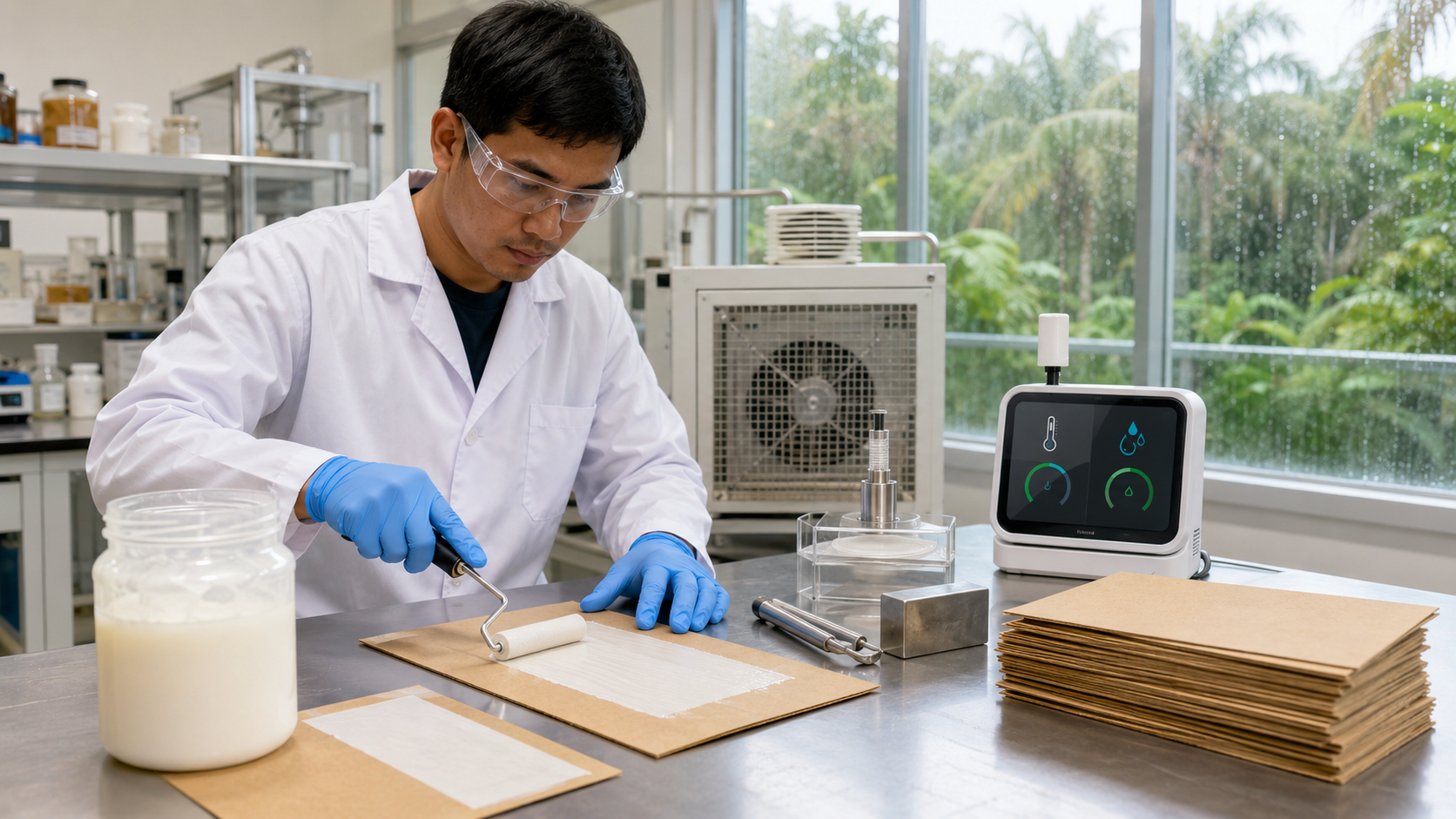
Evaluate Open Time and Setting Speed
The selected VAE emulsion should help the finished adhesive maintain a practical bonding window under warm production conditions. An open time that is too short may cause premature skin formation or inadequate transfer to the second surface.
At the same time, high humidity may delay initial bond development. Manufacturers should test whether bonded parts require additional pressing, holding or drying time.
The appropriate balance depends on the application. High-speed carton sealing requires rapid initial setting, while manual assembly may need a longer open time for positioning.
Consider Viscosity Under Operating Conditions
Viscosity values on a technical data sheet are normally measured under specified laboratory conditions. They may not represent the way an emulsion behaves inside a warm factory.
As temperature rises, the viscosity of some formulations may decrease. This can affect pumping, roller transfer, coating weight, penetration and squeeze-out. Viscosity should therefore be checked at both standard laboratory temperature and the expected production temperature.
Selection should not be based on emulsion viscosity alone. Thickeners, fillers, plasticizers and other formulation components can significantly change the viscosity of the finished adhesive.
Review Film Formation and Water Resistance
Film-forming behavior is another important factor. The selected polymer should form a uniform film under the expected application conditions without drying so rapidly that proper wetting is lost.
Humidity during application should not be confused with water resistance after curing. A VAE adhesive may dry slowly in humid air but still provide acceptable final performance once fully cured. Conversely, easy film formation does not automatically guarantee long-term resistance to water.
If the finished product will experience moisture exposure, evaluate wet adhesion, water absorption and bond retention after controlled water or humidity conditioning.
Check Storage Stability
Prolonged exposure to heat may affect emulsion viscosity, microbial stability and overall shelf life. Containers should be kept closed, protected from direct sunlight and stored according to the supplier’s recommendations.
For tropical storage or long-distance shipping, buyers should discuss expected warehouse temperatures, transport duration, packaging size and inventory turnover with the supplier. Samples exposed to abnormal heat should be inspected for separation, odor, skin formation or major viscosity changes before use.
Test Under Realistic Conditions
Before approving a VAE grade, conduct trials using the actual substrates, formulation and application equipment. Record:
- Temperature and relative humidity
- Substrate type and moisture content
- Coating weight and line speed
- Open time and pressing time
- Initial and final bond strength
- Appearance after storage and moisture exposure
Conclusion
The best VAE emulsion for a hot and humid climate is not necessarily the grade with the lowest viscosity or fastest drying speed. It should provide a workable balance of open time, setting speed, film formation, application consistency and storage stability.
Final selection should be based on controlled trials under representative production and service conditions.
Post time: Aug-31-2026