



Needle-punched carpets and industrial nonwovens rely on fiber entanglement for their basic structure, but many products require an additional binder to improve dimensional stability, surface integrity or downstream handling.
The emulsion has to penetrate the fibrous structure sufficiently without making the finished material unnecessarily stiff. It must also remain stable during mixing, coating and other high-shear processing stages.
GW-9208 is a high-glass-transition-temperature vinyl acetate-ethylene copolymer emulsion in Desay Chemical’s raw-material range. Desay lists needle-punched carpets and nonwoven fabrics among its intended applications and describes the product as an industrial binder with a firm dried film.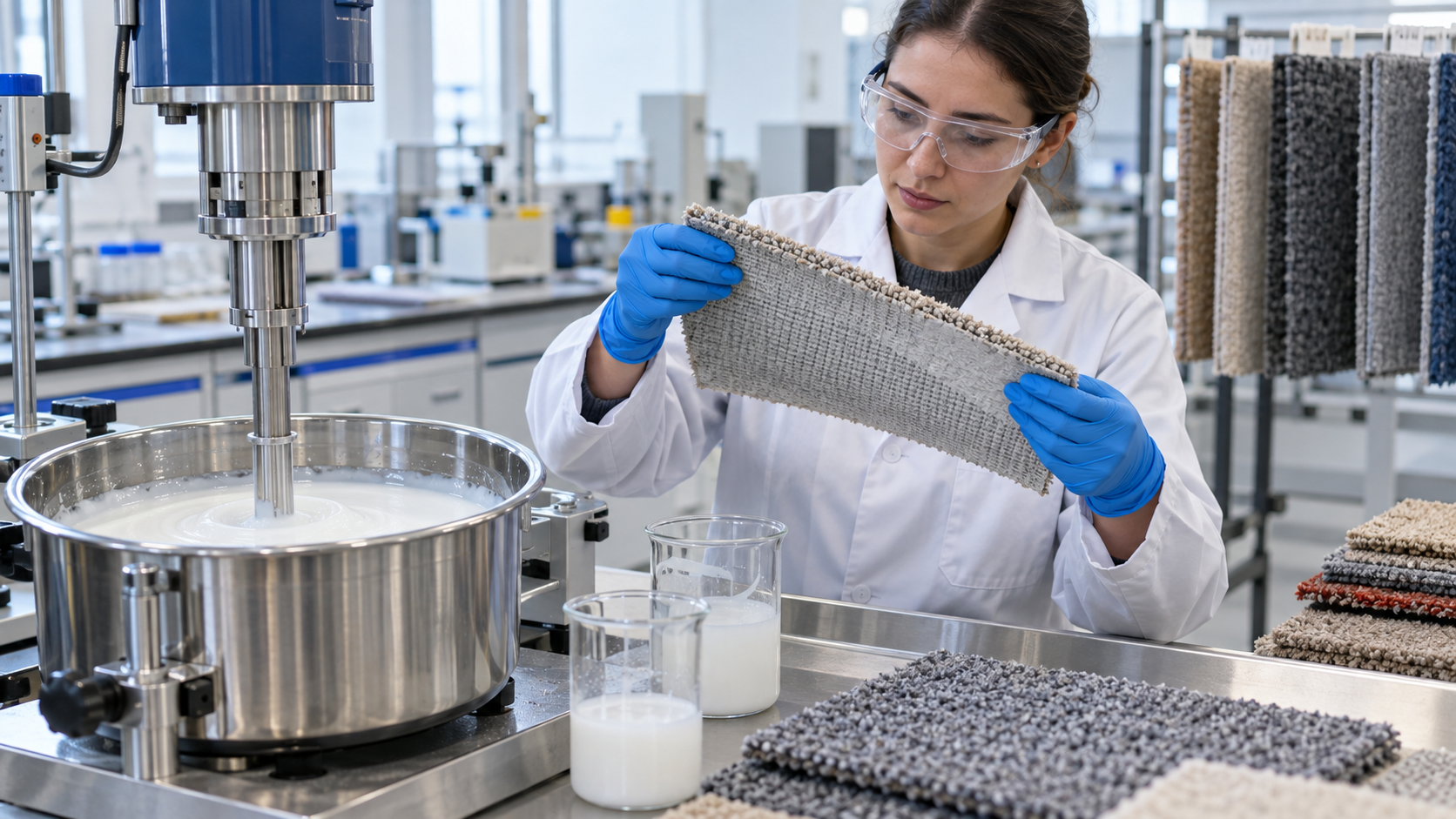
Define the Carpet or Nonwoven Construction
Start by documenting the actual material:
- Fiber type and blend
- Fabric weight and thickness
- Needle-punching density
- Open or compact fiber structure
- Coating on one or both sides
- Required roll width
- Backing or secondary layer
- End-use environment
- Downstream cutting and forming operations
A light automotive nonwoven may require a different stiffness and coating distribution from a heavy exhibition carpet. The binder recommendation must reflect the complete construction.
Understand Why Tg Matters
Glass-transition temperature, commonly abbreviated as Tg, relates to how a polymer film behaves at different temperatures. A comparatively high-Tg binder generally forms a firmer film than a softer, lower-Tg system.
However, high Tg is not automatically better. Excessive film stiffness can negatively affect drape, flexibility or hand feel. Insufficient firmness may allow fibers to loosen or the material to deform during converting.
The correct balance must be determined through formulation and finished-material testing. Request the current GW-9208 TDS for the declared Tg value and measurement method rather than inferring it from the product name.
Check Compatibility with the Full Formulation
A carpet-backing formulation may contain fillers, thickeners, dispersants, defoamers, wetting agents and other functional materials. These components can change viscosity, foam behavior and coating stability.
Prepare controlled laboratory batches and monitor:
- Ease of ingredient addition
- Viscosity development
- Foam generation and release
- Sedimentation
- Coagulation or grit
- Pot stability
- Binder penetration
- Surface appearance after drying
Desay describes GW-9208 as mechanically stable under high-shear conditions. Buyers should confirm this behavior using their own mixer, formulation and processing sequence.
Match Viscosity to the Coating Equipment
Binder can be applied by roller, knife, impregnation or another process-specific method. The formulation must flow through the equipment while remaining distributed across the full web width.
A formulation that is too fluid may penetrate excessively or create uneven pickup. One that is too thick may remain on the surface, produce streaks or overload the coating system.
During pilot trials, record line speed, wet pickup, roller or knife settings, web tension and drying conditions. Inspect material from the center and both edges of the roll.
Control Drying and Film Formation
Drying must remove water from the coated structure without causing migration, surface skinning or uneven binder distribution.
Web weight, coating quantity, dryer temperature, airflow and line speed all influence the result. Do not assume the surface is fully dry simply because it no longer feels wet.
Desay states that GW-9208 forms a firm film with toughness, heat resistance and anti-blocking characteristics. These general emulsion properties must be validated in the complete carpet or nonwoven formulation before commercial claims are made.
Test the Finished Material
Binder approval should be based on the coated product rather than a standalone dried film. Depending on the application, testing may cover:
- Fiber shedding
- Tensile or tear behavior
- Dimensional stability
- Flexibility and hand feel
- Backing adhesion
- Roll blocking
- Cutting-edge integrity
- Heat exposure
- Moisture exposure
- Odor or emissions requirements
Use customer-approved methods and equivalent conditioning periods when comparing samples. Avoid claiming a universal performance level without testing the exact formulation and textile construction.
Plan the Production Trial
Move from laboratory batches to a controlled pilot run before full-scale purchasing. Examine material from the beginning, middle and end of the roll and record all coating and drying settings.
Ask the supplier for current information covering solids content, viscosity, pH, Tg, packaging, storage temperature, shelf life and handling. Any certification or restricted-substance requirement should be supported by documentation for the specific supplied grade.
Post time: Nov-17-2026