



Composite doors often combine metal or wood-based skins with an insulating core. Although this construction appears straightforward, the adhesive must form reliable contact across materials that can differ significantly in surface energy, porosity, stiffness and dimensional behavior.
One-component foaming polyurethane adhesive is commonly considered for this type of assembly because it can be applied as a liquid and cures through contact with moisture. Controlled expansion may help the adhesive contact minor surface irregularities, but excessive foaming should not be treated as a substitute for proper fit, surface preparation or pressing.
Desay Chemical lists PU50 as a one-component polyurethane adhesive for applications involving door panels, metal, wood and insulation materials. Exact processing conditions and performance data should be confirmed against the current technical data sheet and production trials.
Define the Complete Panel Construction
Before selecting an adhesive, document every layer of the panel. A composite door may include galvanized steel, stainless steel, painted metal, plywood, MDF, rock wool, foam board or other core materials.
The supplier needs to know the surfaces that will actually contact the adhesive. For example, bonding to bare steel is different from bonding to an oily, passivated or powder-coated surface. Similarly, a porous mineral-wool core behaves differently from a closed-cell insulation board.
Provide samples from the actual production supply chain. Small changes in protective coatings, release agents or surface treatments can affect adhesion even when the material description remains the same.
Understand Moisture-Curing Conditions
A one-component polyurethane adhesive uses available moisture as part of its curing process. Moisture may come from the atmosphere or the bonded materials, but the correct amount depends on the adhesive and panel construction.
Very dry materials may slow the reaction, while uncontrolled moisture can contribute to excessive foaming or an uneven bond line. Buyers should not add water or change conditioning procedures without following the instructions for the selected grade.
Record workshop temperature, relative humidity and substrate condition during trials. These factors help explain why a process may behave differently between seasons or factories.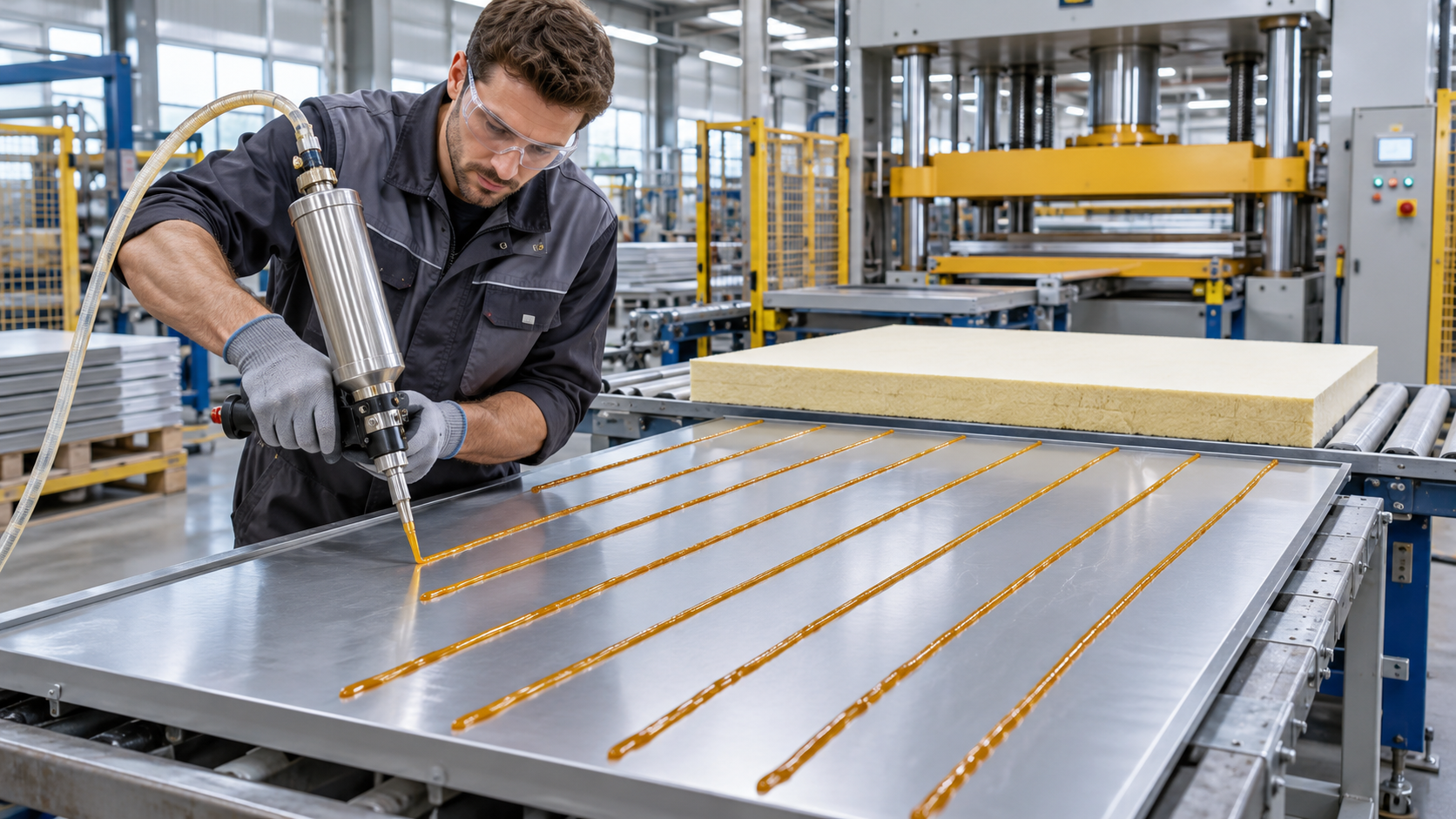
Prepare Metal Skins and Core Materials
Metal surfaces should be clean and free from dust, loose corrosion, oil and processing residue. If a cleaner or pretreatment is used, confirm that it does not leave a film that interferes with bonding.
Core materials should be flat, dimensionally consistent and free from loose particles. Large gaps between the skin and core can create areas with inadequate contact even if the adhesive expands during curing.
Surface preparation procedures should be established before adhesive candidates are compared. Otherwise, the results may reflect inconsistent cleaning rather than differences between products.
Control Adhesive Application
The adhesive may be applied in beads or another controlled pattern suited to the panel dimensions and equipment. The objective is uniform distribution after pressing without excessive squeeze-out or unfilled areas.
Application rate, bead spacing and assembly time should be determined through trials. Applying more adhesive does not automatically produce a better panel. Excess material can increase cost, create uncontrolled expansion and make cleaning more difficult.
For an accurate recommendation, tell the supplier whether application is manual or automated, the panel size, target line speed and the time between application and pressing.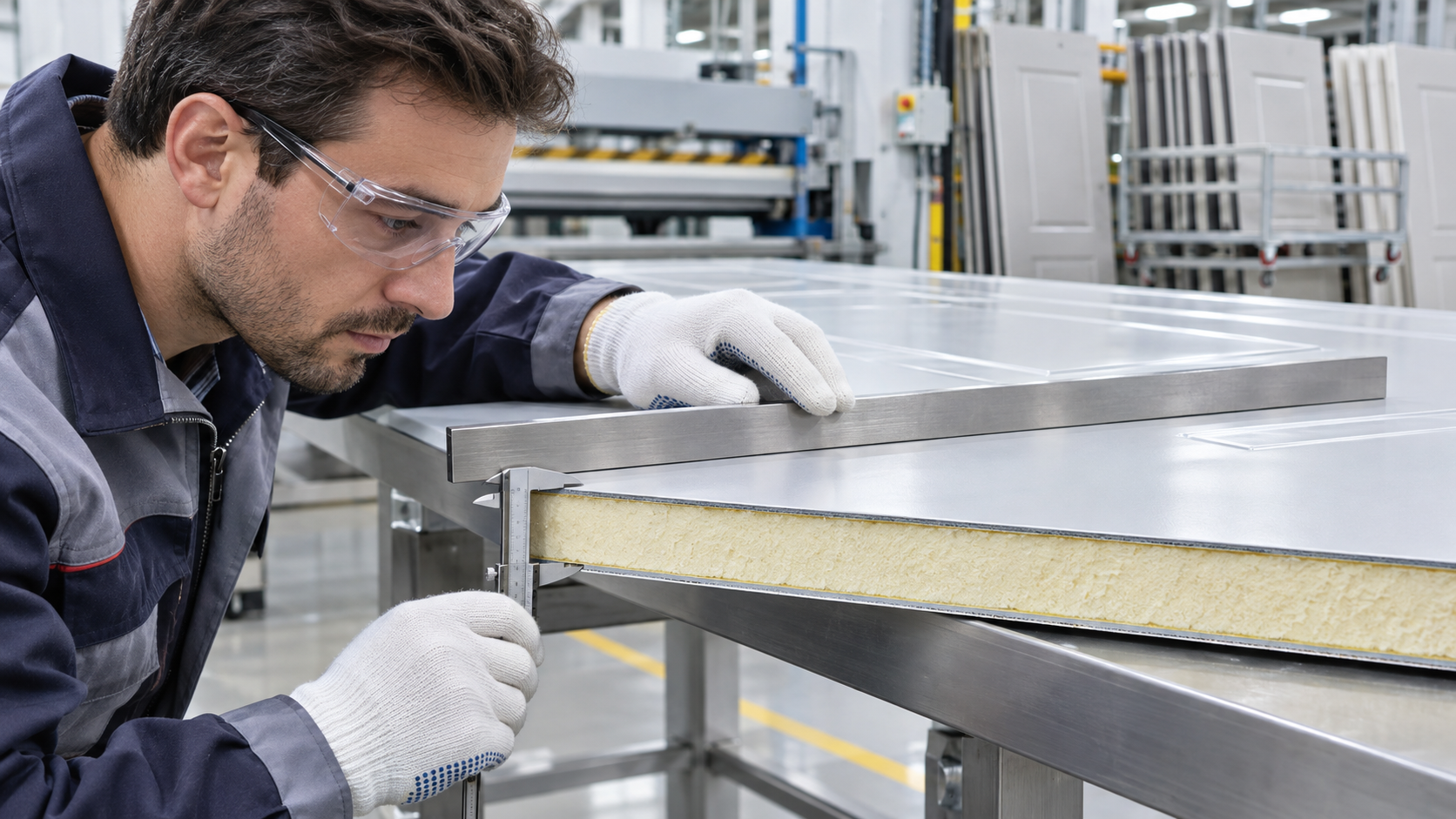
Match Pressing to the Panel
After the core and skins are assembled, the panel must remain aligned while the adhesive develops sufficient handling strength. Pressure should maintain contact and panel flatness without crushing the insulation core.
The appropriate pressure, press duration and release schedule depend on the substrates, panel thickness, adhesive quantity and factory conditions. Use the processing guidance for the specific grade rather than applying a universal pressing time.
Check panels immediately after removal from the press and again after an agreed conditioning period.
Run Full-Size Production Trials
Small bonded coupons are useful for screening, but they do not reproduce the behavior of a complete door. Produce full-size panels at normal production speed and evaluate:
- Adhesive coverage across the panel
- Skin flatness and surface appearance
- Core displacement or compression
- Edge and corner bonding
- Local swelling or excessive expansion
- Stability during trimming and hardware installation
- Bond integrity after relevant conditioning
Any strength, temperature-resistance, fire-related or durability requirement must be verified using appropriate tests on the finished panel. It should not be inferred from the adhesive family alone.
Post time: Nov-23-2026