



Paper tubes and cores may look simple, but their production places demanding requirements on the adhesive. Several kraft paper strips must be coated, aligned and wound around a mandrel while the line continues to move. The adhesive must spread consistently, provide early holding strength and allow moisture to leave the multi-layer structure.
Choosing paper tube glue is therefore a process-matching decision. Buyers need to consider paper absorbency, tube dimensions, application equipment, winding speed and downstream cutting—not only the nominal strength of the dried adhesive.
Desay Chemical offers a water-based paper tube core glue for kraft paper bonding, spiral winding and paper core manufacturing. The published product information describes a polyvinyl alcohol and kaolin-based liquid intended for paper tube production lines.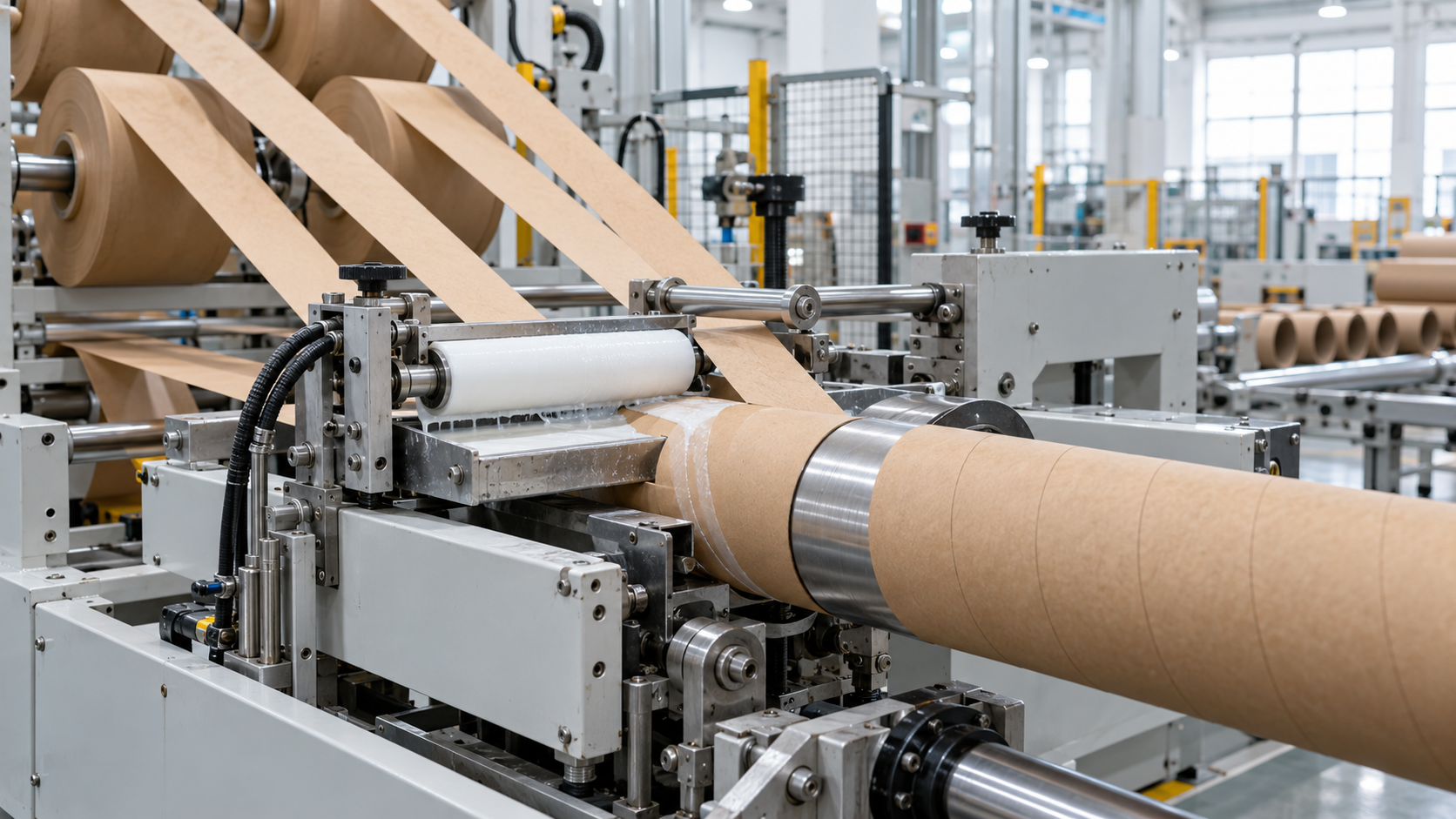
Define the Tube Construction
Start by specifying the tube that will be manufactured. Important details include:
- Kraft paper grade and grammage
- Virgin or recycled fiber content
- Number and width of paper plies
- Finished tube wall thickness
- Internal and external diameter
- Winding angle
- Required cutting length
- Intended use of the finished core
A core for packaging film, textiles or paper rolls may have different dimensional and compression requirements from a lightweight mailing tube. The adhesive recommendation should reflect the actual structure.
Send the supplier samples of every paper grade used in the tube. Surface sizing, moisture and recycled-fiber content can change adhesive penetration even when two papers look similar.
Match Adhesive Flow to the Coating System
Paper tube adhesive may be transferred by rollers, immersion equipment, nozzles or other machine-specific systems. Its flow must support uniform application without excessive dripping, foaming or accumulation around the coating unit.
If the adhesive penetrates the kraft paper too quickly, insufficient material may remain between the layers. If it sits too heavily on the surface, the tube may retain excess moisture or experience greater squeeze-out.
Viscosity values are only useful when the test method and temperature are known. Desay publishes initial viscosity and solid-content information for its paper tube glue, but buyers should confirm the current specification and measurement method for the supplied batch.
Coordinate Adhesive Setting with Line Speed
A spiral winding line needs enough initial adhesion to prevent the paper strips from shifting or separating as the tube leaves the mandrel. At the same time, the glue must remain workable long enough for coating, alignment and winding.
A laboratory test performed slowly by hand cannot reproduce this balance. Run trials at the intended production speed and observe:
- Paper tracking before the mandrel
- Adhesive distribution across each ply
- Movement of the spiral seam
- Tube stability after leaving the winder
- Adhesive build-up on belts, rollers and cutters
- Changes when the line starts or stops
Record machine settings for each trial. This makes it easier to distinguish an adhesive issue from incorrect web tension, application quantity or paper alignment.
Manage Moisture in Thick-Walled Tubes
Water must leave the adhesive layer as the tube sets. Drying becomes more challenging when the wall contains many plies or when the tube is produced in a cool, humid workshop.
Do not assume that a tube is fully conditioned simply because its outside feels dry. Retained moisture can influence cutting, dimensions, hardness and later storage behavior.
Factories producing thick cores may need a longer conditioning period or controlled drying. The appropriate method should be established through production trials rather than applying one drying schedule to every wall thickness.
Inspect the Finished Paper Core
Quality evaluation should cover the complete tube rather than a small glued paper sample.
Inspect trial cores for:
- Open or lifted spiral seams
- Unbonded areas between layers
- Out-of-round shape
- Telescoping or movement between plies
- Edge damage during cutting
- Excessive shrinkage or deformation
- Delamination during downstream handling
Cut samples from the beginning, middle and end of a production run. Examine their cross-sections to check whether the layers remain in close, consistent contact.
Compression, moisture and dimensional tests should follow the buyer’s finished-product requirements. Do not claim a universal compression value or water resistance unless it has been verified for the exact tube construction.
Information to Provide When Requesting a Sample
A useful inquiry should include paper grades, ply count, tube diameter, wall thickness, winding speed, coating system, drying conditions and required finished-core tests.
Desay Chemical’s product page lists the adhesive for paper tubes, paper cores, spiral winding and kraft paper bonding. Specific solids, viscosity, packaging, storage and application recommendations should be reconfirmed in the current TDS before production approval.
Post time: Oct-12-2026